
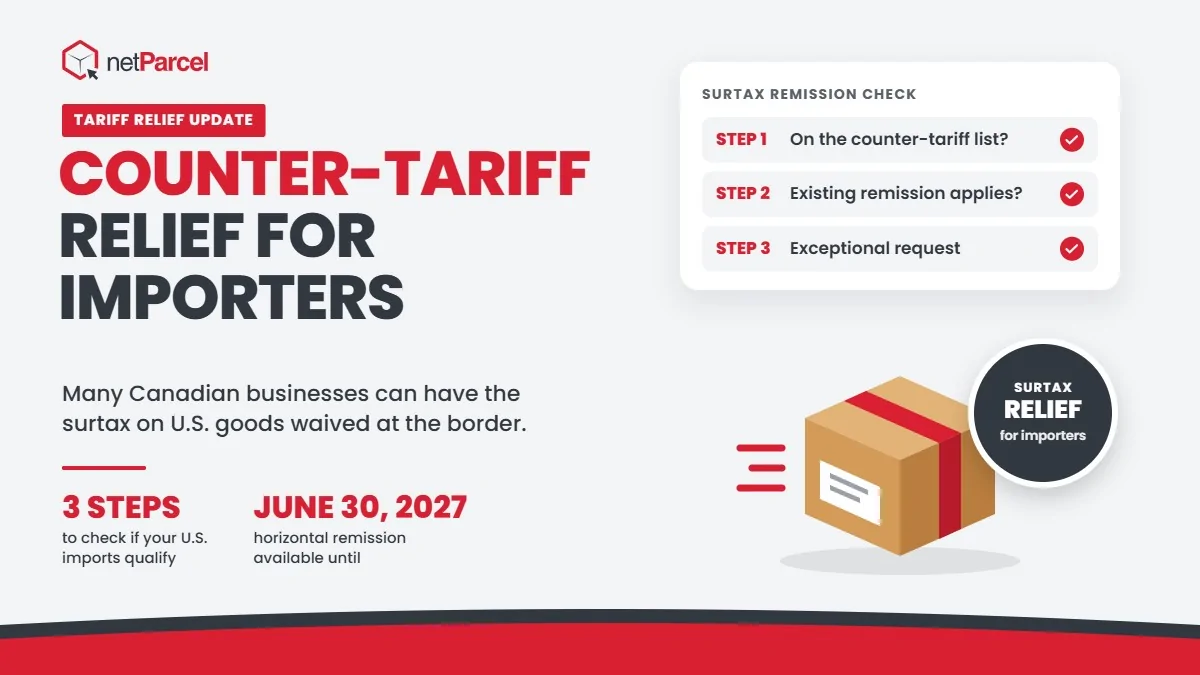
Canada’s counter-tariff relief applies to more businesses than most people realize. If you bring goods in from the U.S., some of those shipments may now carry a surtax. Many importers can have that surtax waived at the border without filing anything with Ottawa. Others can apply for relief, or get the money back when the goods leave Canada again.
Since the latest round of counter-tariffs took effect on September 8, 2026, many netParcel customers have asked us the same thing: do I actually have to pay this? Here’s how to work it out, in three steps.
Step 1: Check whether your U.S. imports face a counter-tariff
The surtax only applies to specific U.S. products, not everything that crosses the border. Your first move is to look up your goods on the government’s list of U.S. products subject to counter-tariffs.
Even if your product is on that list, you won’t owe the surtax on goods that:
- were already in transit when the tariffs came into force
- come in under the Import for Re-Export Program
- are imported through Campobello Island, New Brunswick
If that’s you, you don’t need to remit anything, and you can stop here.
One thing we see trip people up: the list is organized by tariff classification, so getting your HS codes right matters. If you’re not sure how your products are classified, please consult our resources before your next shipment.
Step 2: See if you already qualify for counter-tariff relief
For most businesses, this is where Canada counter-tariff relief actually comes from. The United States Surtax Remission Order (2025) already gives relief to a wide range of imports, and it covers the new measures too. You don’t need to apply to Finance Canada to use it.
Broad-based (horizontal) remission
Any importer can claim this relief, under Sections 1, 2, 3 and 3.1 of the Order, for:
- goods used in public health, health care or public safety
- steel used to make cars or aircraft
- non-steel goods used in Canada for manufacturing, processing, food and beverage packaging, or farming
That last group is broad. It includes direct inputs and the machinery used in those activities.
Product-specific remission
Schedules 1, 2, 3 and 6 of the Order list hundreds of products that the government has found aren’t made in Canada, including many steel inputs. Remission on those products carries over to the new tariffs.
How to claim it at the border
If your goods qualify under either type, you don’t pay the surtax and wait for a refund. You put the right CBSA authorization code on your customs declaration, and the surtax is waived on entry. The “How to apply” section of CBSA Customs Notice 25-19 lists the codes and steps.
Two things to keep in mind:
- The deadline. Horizontal remission is available retroactively and going forward until June 30, 2027. If you paid the surtax on eligible goods earlier, it’s worth looking back.
- Your paperwork. There’s no master list of goods that qualify for horizontal remission. It’s up to you to show how the goods were used, so keep records that link each import to its purpose.
Step 3: Decide whether to file an exceptional remission request
If nothing above covers your goods, you can still ask Finance Canada for counter-tariff relief through a remission request. They’ll look at requests where:
- you use the goods as inputs and can’t reasonably source them in Canada (nationally or regionally) or from outside the U.S., or
- there are other exceptional circumstances that could seriously hurt the Canadian economy
Each request is reviewed on its own merits. To build one, describe what’s affecting your business, gather evidence of the supply problem or economic impact, and send it in. The government’s United States Remission Framework explains what to include.
A note for anyone who buys U.S. goods through a distributor: you can file the request yourself, but if it’s approved, only the importer of record can claim the remission. Talk to your distributor early so the savings actually reach you.
Other ways to reduce or recover the surtax
Certain motor vehicles
Any importer can get remission on certain vehicles listed in Schedule 1, Section 4.3 and Schedule 5 of the Remission Order. These include recreational vehicles, ATVs, UTVs and side-by-sides, hearses, ambulances and hospital transfer vans, and police vans.
Chapter 98 and 99 goods
Goods entered under certain special classification items in Chapter 98 or 99 of the Customs Tariff aren’t subject to the surtax. Some of those items are still covered, though. Check Schedules 3 and 4 of the United States Surtax Order (Steel and Aluminum 2025) and Schedule 4 of the United States Surtax Order (2026) to be sure.
Goods you export
If you paid the surtax and no remission applies, you may be able to recover it when you export the goods. CBSA’s Duties Relief Program and Duty Drawback Program are the two options to look at.
Quick checklist
- Look up your products on the counter-tariff list.
- Rule out the in-transit, re-export and Campobello Island exemptions.
- Check the Remission Order for horizontal or product-specific relief.
- Put the correct CBSA authorization code on your declarations.
- Keep records showing how you use imported goods.
- Review past entries before the June 30, 2027 cut-off.
- File an exceptional remission request if nothing else fits.
- Look at Duties Relief or Duty Drawback for goods you export.
Canada counter-tariff relief: common questions
Do Canada’s counter-tariffs apply to all U.S. imports?
No. They only apply to specific products on the government’s list. Goods that were in transit when the tariffs started, goods under the Import for Re-Export Program, and goods imported through Campobello Island are exempt.
Do I have to apply to get surtax remission?
Usually not. If your goods qualify under the United States Surtax Remission Order (2025), you claim the relief at the border with a CBSA authorization code on your declaration. You only need to apply to Finance Canada for an exceptional remission request.
How long is horizontal remission available?
Until June 30, 2027. It applies both to past imports and to new ones until then.
Can I get relief if I buy U.S. goods from a distributor?
You can submit a remission request as a downstream user, but only the importer of record can claim it once it’s granted. You’ll need your distributor to pass on the savings.
Who do I contact with questions about remission?
Email the Department of Finance at remissions-remises@fin.gc.ca. For more on the government’s tariff response and support programs, see Canada.ca/Tariff-Response and Canada.ca/CanadaStrong.
Shipping from the U.S.? We can help
Counter-tariff rules keep shifting, and a missing authorization code or the wrong HS code can mean paying a surtax you didn’t owe. netParcel helps Canadian businesses ship across the border with fewer customs surprises. If you’re not sure how Canada’s counter-tariffs affect your shipments, or whether you qualify for relief, contact our team.
This article is general information, not legal, tax or customs advice. Tariff measures and remission rules can change, so confirm the details with the Government of Canada, CBSA or a licensed customs broker before you make import decisions.

