
If you ship parcels to customers in the European Union, there’s a significant customs change taking effect in one week that will impact how your shipments are processed and what your customers may owe at the border.
What’s changing?
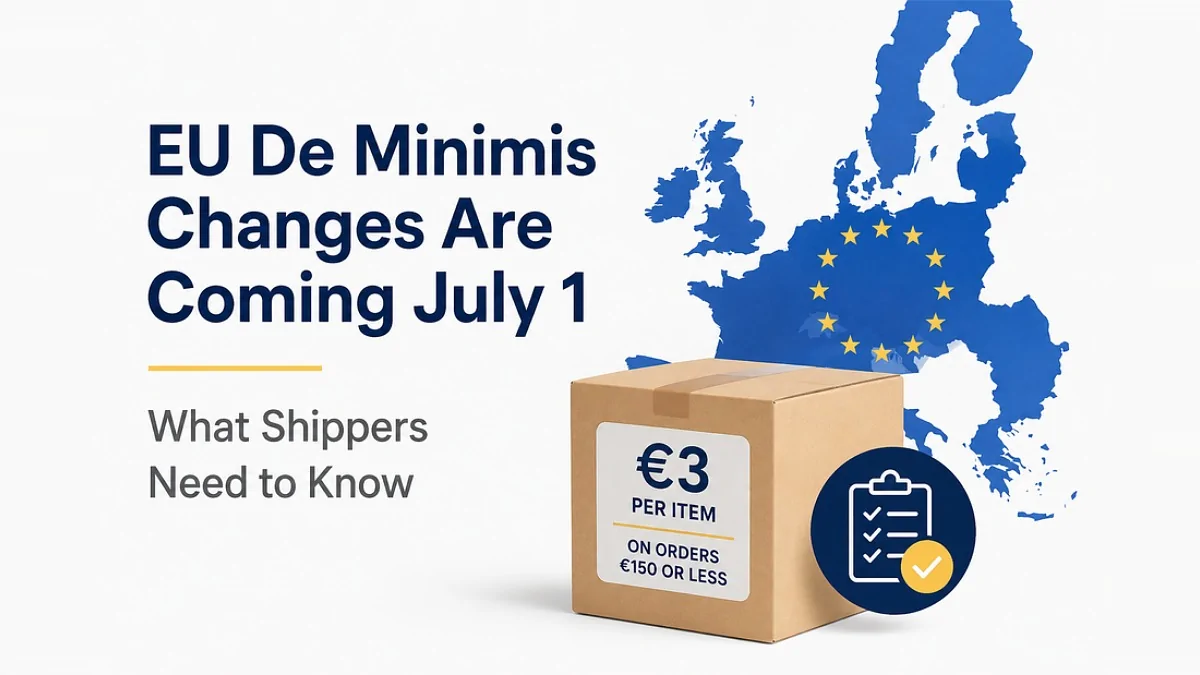
Until June 30, goods valued at €150 or less entered the EU completely duty-free. That exemption is gone as of July 1, 2026. Under new EU legislation (Council Regulation 2026/382), a flat €3 customs duty now applies per item on all B2C distance sales, meaning online orders shipped directly to EU consumers, valued at €150 or less.
The €3 is charged per HS tariff line, not per parcel. If your package contains two different product types – say, a t-shirt and a pair of socks, that’s two separate €3 charges, totalling €6. Multiple units of the same product in the same HS category count as one charge.
This transitional flat rate runs until July 1, 2028, at which point normal ad valorem tariff rates take over for all shipments regardless of value.
Does this apply to your shipments?
If you’re shipping B2B to a VAT-registered business in the EU, the €3 flat duty does not apply; standard tariff rates apply instead, as before. The new duty specifically targets B2C “distance sales,” where a seller or platform arranges transport to an EU consumer. If that describes your cross-border e-commerce, you’re affected.
What about VAT?
If you’re registered under IOSS and collecting VAT at checkout, that process doesn’t change. The €3 duty and VAT are two separate, parallel obligations. The duty doesn’t inflate your VAT base.
A critical detail on returns
The €3 duty is non-refundable on returned goods. For high-return product categories like fashion or footwear, this is a real cost to factor into your unit economics. Build it into your return cost models now.
What you should do before July 1
The most pressing action items for Canadian shippers:
First, make sure your product data is complete and accurate; every shipment to the EU needs specific goods descriptions (not generic terms like “clothing” or “gift”), a correct HS code, country of origin, and declared value per item. Vague descriptions are the leading cause of customs holds.
Second, decide how you’ll handle the duty; either absorb it and ship DDP (Delivered Duty Paid), collecting the €3 from your customer at checkout, or ship and have it collected at delivery. Whichever you choose, make sure your customers know what to expect before they order.
Third, note that Product Identifiers (PIDs), a Merchant ID, a Manufacturer ID, and a Standardized ID like a barcode will be voluntary starting July 1 but become mandatory on November 1, 2026. Getting your product data organized now will save headaches later.
The bottom line
Shipping low-value goods to EU consumers is getting more complex and marginally more expensive. The duty itself is small, but the compliance requirements around it (accurate data, correct declaration types, the right duty model) are where most issues will arise. Get your product catalogue in order, update your checkout or shipping terms to reflect the new cost, and make sure your carrier is set up to handle the new declaration requirements.
We’ll continue monitoring this as the final implementing legislation is published and will share any updates that affect netParcel customers.
While we strive to provide accurate and up-to-date information, netParcel is not a licensed customs broker. For shipment-specific customs clearance questions or concerns, we recommend consulting a licensed customs broker or your carrier’s brokerage department.
Important update: Canada Post has paused shipments to 11 EU countries
Canada Post is temporarily not accepting mail or parcels addressed to Austria, Belgium, Czech Republic, Denmark, Finland, France, Germany, Ireland, Luxembourg, Portugal, and Spain, effective immediately and until further notice.
If you ship to any of the 12 affected countries via Canada Post, you’ll need an alternative carrier until service resumes. We’re monitoring this closely and will update this post as Canada Post provides more information.
Thank you,
netParcel AM


