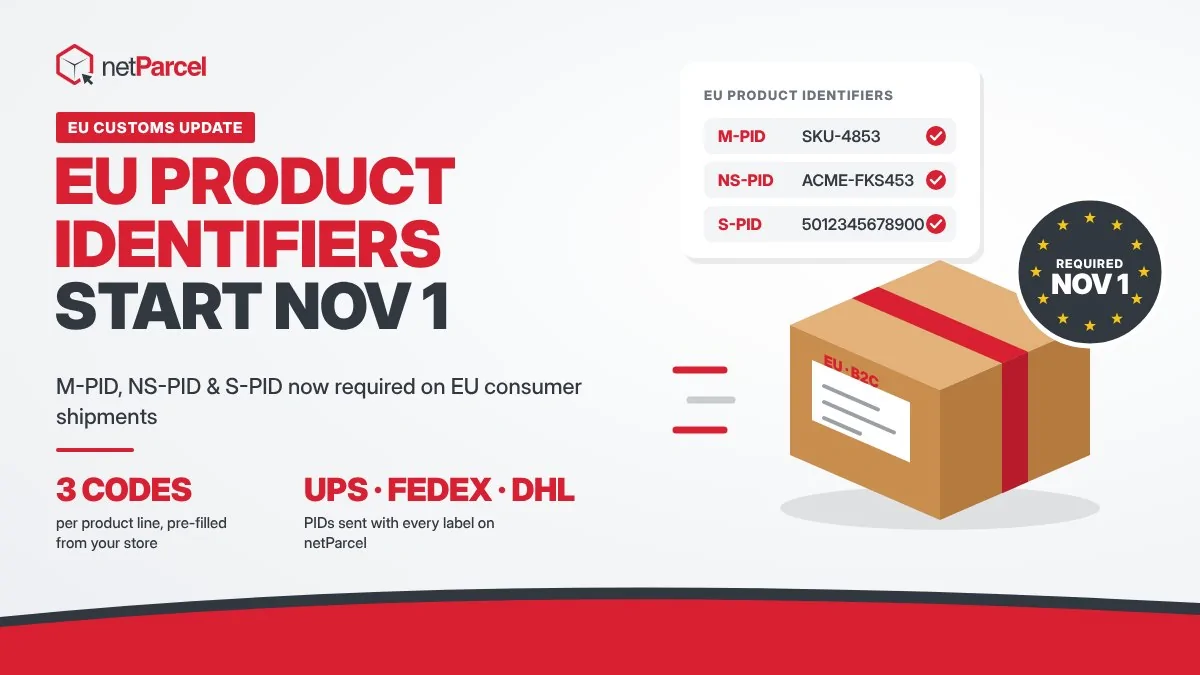
Starting November 1, 2026, the European Union requires EU product identifiers (PIDs) on every business-to-consumer (B2C) shipment into the EU. It is part of the EU’s ongoing customs reform, so it applies to every carrier, not just one. If the PIDs are missing, customs can hold your parcel or send it back to you, and some carriers won’t create the label at all.
The good news for netParcel customers: PID support is already live on the platform. netParcel builds the fields into the commercial invoice, sends them to UPS, FedEx and DHL Express automatically, and pre-fills them from Shopify, eBay and PayPal orders where the data exists.
Below is what changes, which carriers are ready, and what you need to do before November 1. Shipping from Canada to the EU and new to netParcel? Create a free account and the PID fields are ready to use.
What are EU Product Identifiers (M-PID, NS-PID, S-PID)?
Each product line on an EU B2C shipment needs up to three identifiers:
| PID | What it is | Required? | Example |
|---|---|---|---|
| M-PID Merchant Product Identifier | Your own SKU, item code or listing ID | Yes | SKU-4853 |
| NS-PID Non‑Standardized Manufacturer PID | The manufacturer’s model, part or style number (MPN) | Yes | ACME-FKS453 |
| S-PID Standardized Manufacturer PID | A global barcode: GTIN, EAN, UPC or ISBN | Only if one exists; otherwise “NO” | 5012345678900 |
You enter identifiers per product line, not per parcel. For example, a box with three different products needs three sets of PIDs.
Who has to comply with the EU product identifier rules?
- B2C shipments to any of the 27 EU countries valued at €150 or less. The EU is amending the rule to set this €150 limit, so higher-value shipments won’t need PIDs. netParcel still asks for PIDs on every EU consumer shipment, so you’re covered either way.
- B2B shipments to a VAT-registered business don’t need PIDs. However, in netParcel the PID fields still appear but stay optional.
- Shipments to the UK, Switzerland, Norway and other non-EU countries don’t need PIDs.
EU product identifier key dates by carrier
Carriers are enforcing PIDs on their own timelines, some ahead of the EU date:
- UPS: PID validation began October 25, 2026
- FedEx: PID fields mandatory since October 26, 2026
- EU-wide requirement (all carriers): November 1, 2026
Which carriers support EU product identifiers on netParcel?
netParcel has built and tested PID transmission with UPS, FedEx and DHL Express:
- UPS: netParcel sends PIDs with each product line on your shipment.
- FedEx: netParcel sends PIDs electronically through the FedEx API, along with the recipient email FedEx now requires for EU consumer shipments.
- DHL Express: netParcel sends PIDs as line-item references, in the format DHL confirmed.
PIDs only count if they travel with the label
Having PIDs in your product catalogue isn’t enough. They only reach EU customs if the carrier receives them when you create the shipping label. netParcel transmits them to the carrier with every label, so the data customs needs travels with your parcel.
Automatic EU product identifier import from Shopify, eBay and PayPal
Typing three codes per item on every order isn’t realistic for busy sellers. netParcel pre-fills PIDs from your connected store wherever the data exists, and shows where each value came from (From Shopify, From eBay, From PayPal, Saved from last shipment, Default or Entered by you):
- Shopify: M-PID from the variant SKU (or variant ID), S-PID from the variant barcode when it is a valid GTIN/EAN/UPC/ISBN, and NS-PID from an MPN metafield on your products. Tip: add an MPN metafield in Shopify (Settings → Metafields and metaobjects → Products).
- eBay: M-PID from your eBay listing ID, NS-PID from the listing’s MPN, and S-PID from the EAN, UPC or ISBN, including the exact variation the buyer purchased.
- PayPal: M-PID from the item code your checkout sends. PayPal doesn’t carry MPNs or barcodes, so you add the NS-PID once and S-PID defaults to NO.
- netParcel API: developers can pass
merchant_pid,manufacturer_pidandstandard_pidper item.
netParcel remembers your PIDs. Once you create a label, netParcel saves the codes for that product. The next order for the same item fills in automatically. If you later fix a barcode in Shopify, netParcel uses the newer Shopify value unless you edited that field here, and any correction you make by hand always wins. On manual shipments, type the M-PID and the other two fill in from your saved values.
Built-in checks so shipments don’t get stuck
- The PID section opens automatically on EU consumer shipments once the fields are mandatory for your carrier.
- netParcel highlights a missing M-PID or NS-PID in red and holds the label until you fill it in, so a parcel never leaves without them.
- netParcel accepts “NO” or “NOT APPLICABLE” for NS-PID and S-PID when no such code exists. M-PID always needs a value, since every seller has its own product code.
- netParcel check-digit validates barcodes and warns you if a code looks wrong.
- Your PIDs print under each product on the netParcel commercial invoice.
Your EU product identifiers checklist for November 1
- Make sure every product you sell into the EU has a SKU (M-PID).
- Collect manufacturer part numbers (NS-PID). If you make the product yourself, your own model number works.
- Add GTIN/EAN/UPC barcodes (S-PID) to your store listings where they exist.
- Shopify sellers: create an MPN metafield.
- Add the customer’s email address on FedEx EU shipments.
FAQ
When do EU product identifier requirements start?
November 1, 2026. Reporting was voluntary from July 1, 2026. UPS began validating on October 25 and FedEx on October 26.
Do PIDs apply to low-value parcels?
Yes. Low-value consumer parcels are exactly what the rule targets. The EU is amending the regulation to limit PIDs to shipments valued at €150 or less, so higher-value shipments won’t need them. netParcel still collects PIDs on every EU consumer shipment, so a borderline value never catches you out.
What if my product has no barcode?
Enter NO for S-PID, because only M-PID and NS-PID always need a code.
Do I need PIDs for B2B shipments?
No, not for shipments to VAT-registered EU businesses. The fields are optional.
What happens if my parcel arrives without EU product identifiers?
Customs can hold the parcel or send it back to you, and some carriers won’t create the label at all. Parcels that reach the EU on or after November 1 without PIDs face the same risk, so add your identifiers before the parcel leaves Canada. netParcel sends them to the carrier with every label. For a walkthrough of where to find each code, see this EU product identifiers guide.
Ship to the EU with compliant product identifiers
EU customs rules keep changing, from the end of the €150 duty-free threshold to the new PID requirement. netParcel does the heavy lifting so you don’t have to: discounted rates from leading carriers, PIDs pulled from your store, and checks that catch problems before your parcel reaches customs.
Log in to netParcel to review your EU shipments, or create a free account to start shipping to Europe with compliant product identifiers. Want to compare prices first? Get a quote or see how netParcel works.